
Demand for custom large-scale bronze work has grown steadily among municipalities, universities, veterans groups, and private families. First responder memorials, campus mascots, and personalized family tributes are all driving fresh commissions across the country.
This guide covers the terminology, types, costs, famous examples, and current trends shaping large and life-size statues, plus what to look for when commissioning your own.
Key Takeaways
- Scale runs from life-size (1:1) to monumental (50+ ft)—cost and timeline jump at each step
- Bronze is the outdoor memorial standard for durability and a museum-quality finish
- Cost tracks size, material, detail, and foundry workflow—not a flat per-foot rate
- An in-house foundry (design through casting) means tighter quality control and fewer delays
What Are Large and Life-Size Statues Called?
The art world uses specific terms, and getting them right matters when you're briefing a foundry.
Monumental sculpture refers to work of "very large size," according to the Getty Research Institute's Art & Architecture Thesaurus. Getty's own definition offers no fixed dimensional cutoff. It's a category, not a measurement.
Colossal statue is more specific. Britannica defines a colossus as a statue "considerably larger than life-size." Reserve this term for work that's clearly, dramatically over-scale, not standard life-size portraiture.
Life-size sculpture means a 1:1 ratio between the artwork and its subject. This is the standard for most memorial and mascot commissions. The goal is a recognizable, human-scale presence rather than an oversized statement piece.
Large-scale art is broader still. It covers murals, installations, and any artwork exceeding typical human proportions, whether or not it's a sculpture at all.
When commissioning, skip the vague adjectives. Specify the exact figure height, base height, and total installed height instead.
The Four Main Types of Sculpture
Sculptors work in four main forms, and each carries different engineering and production demands.
| Type | What It Is | Best For |
|---|---|---|
| Relief | Forms projecting from a flat background | Wall panels, narrative memorials, tight sites |
| Freestanding/in-the-round | A detached 3D object viewable from all sides | Municipal statues, mascots, portrait figures |
| Kinetic | Sculpture that moves via motors or wind | Modern installations, interactive plazas |
| Assembled | Multiple materials or cast sections joined together | Complex, multi-figure or mixed-material works |

Freestanding (sculpture-in-the-round) pieces dominate memorial, mascot, and corporate commissions. Viewers need to walk around them, so every angle has to hold up. Whatever the form, large-scale work still comes down to how the piece is made.
Casting vs. Carving vs. Modeling
Three production methods get mixed up often:
- Carving: removes material (subtractive), as with marble or granite
- Modeling: builds material up, usually clay over an armature
- Casting: pours molten material into a mold made from that model
Bronze work uses modeling and casting together. Big Statues' process starts with a clay model built over a steel armature, then moves to mold-making before the bronze pour. The final metal statue is never carved directly.

Iconic Large and Life-Size Statues Across America
Some American statues have become cultural shorthand. Here's what makes them notable:
- Statue of Liberty — Copper, standing 151 feet 1 inch tall (305 feet with pedestal), dedicated in 1886 as a Franco-American friendship gift, per the National Park Service
- U.S. Marine Corps War Memorial — Bronze figures standing 32 feet tall, raising a 60-foot flagpole, dedicated in 1954 to honor fallen Marines
- Ulysses S. Grant Memorial — Bronze and marble, with Grant depicted at 2.5 times life-size, dedicated 1922 on the U.S. Capitol Grounds
- Pioneer Woman "Confident" — A 17-foot bronze figure on a 40-foot base in Ponca City, Oklahoma, honoring homesteading women
- Mustangs of Las Colinas — Nine larger-than-life bronze horses in Irving, Texas, the centerpiece of a 1984 development project

These monuments share a purpose: commemorating history, honoring service, or marking identity. That same instinct drives smaller-scale commissions today.
Big Statues has produced work in a similar spirit. The studio created a bronze statue of Bob Moore, founder of Bob's Red Mill, for the brand's Milwaukie, Oregon headquarters on his 90th birthday. It also completed two public art pieces, "Feel the Love" and "I, Too, Am America," for West Plains, Missouri. The commissions are smaller than national landmarks, but the purpose matches: bronze makes a story permanent.
How Much Does a Large Statue Cost?
There's no single price-per-foot answer here. Cost depends on several interacting factors.
Primary cost drivers:
- Size and scale — larger figures need more material, bigger molds, and often multiple cast sections
- Material — bronze costs more upfront than resin but lasts generations longer outdoors
- Design complexity — intricate clothing, facial likenesses, or multiple figures add sculpting hours
- Number of figures — a solo portrait costs far less than a multi-figure memorial group
Custom commissions move through distinct stages, and each one adds to the total:
- Design consultation
- Clay sculpting
- Mold-making
- Wax casting and bronze pouring
- Finishing
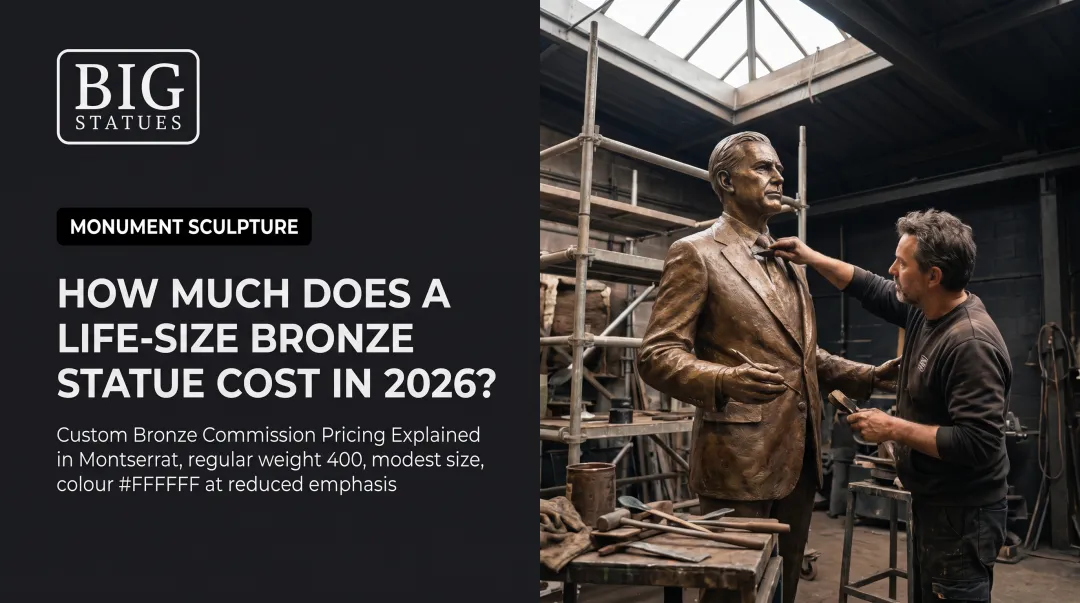
Big Statues' projects generally start at a $5,000 minimum and scale with scope. Most municipal and memorial commissions run well beyond that entry point.
Why In-House Production Matters for Cost
Foundries that outsource each stage (sculpting here, casting there) add delays and markup at every handoff. Big Statues handles design, sculpting, mold-making, and casting under one roof, with client approval gates before work moves forward.
Keeping production in-house limits stacked markups and keeps the schedule clearer: four to eight months from signed agreement to delivery, depending on size and complexity.

When you request quotes, ask each foundry to break out design, sculpting, mold-making, casting, and finishing. A stage-by-stage bid makes it easier to compare proposals on equal terms.
Where to Buy or Commission a Large Outdoor Statue
Buyers generally choose between two paths.
Pre-made statues are faster and cheaper but limited to existing designs. They work for generic decorative pieces, not memorials or brand-specific mascots.
Custom commissions start from a blank slate: photographs, reference images, sketches, and often a scale miniature before full sculpting begins. This is the route for anyone honoring a specific person, pet, or brand identity.
What to Look for in a Foundry
Before signing anything, evaluate:
- In-house capability — does the studio handle design, sculpting, and casting internally, or subcontract each stage?
- Material sourcing — is the bronze domestically produced, and what's the alloy composition?
- Portfolio depth — has the foundry completed projects similar to yours (municipal, veterans, university, corporate)?
- Delivery track record — can they commit to a realistic timeline and stick to it?
Apply those checks to any studio you shortlist. Big Statues, for example, has operated as a bronze foundry for over 25 years, with design, sculpting, and molding under one roof using 100% USA bronze.
Portfolio examples include:
- Municipal art in West Plains, Missouri
- Corporate sculpture for Bob's Red Mill
- University mascots such as Bucky the Buccaneer at East Tennessee State University
- Veterans and public-safety memorials, including the Fallen Officer Memorial in Lompoc, California
Match the foundry's past project types to yours, and confirm in-house production before you sign.
Current Trends in Large-Scale Sculpture
Public art commissioning has shifted in a few clear directions recently. Donor-funded civic monuments. Communities are funding permanent bronze landmarks through public donation campaigns. Pittsburg, Texas ran one for a life-size Carroll Shelby statue, setting a $95,000 fundraising goal with installation planned for spring 2025. First responder and veterans memorials. Burnsville, Minnesota installed life-size bronzes of a firefighter, paramedic, and police officer in 2024. Council Bluffs, Iowa has a similar donor-funded plaza honoring public-safety personnel. Big Statues has completed comparable work, including the Fallen Officer Memorial in Lompoc, California, and the Flying Doves Pentagon Marine War Memorial. University mascot and athletics statues. Campuses continue investing in branded public art as gathering spots and photo landmarks. The University of Toledo unveiled donor-funded bronze mascots on its Centennial Mall in 2024, and Stony Brook University installed a 7-foot bronze mascot the same year. Big Statues' university portfolio includes:
- Coach Bill Hayes at Winston-Salem State University
- The Diondre Overton Memorial in Greensboro, North Carolina
- Legion the Bulldog at Marlin High School
- Rowdy the Roadrunner at MSU Denver Personalized family and pet memorials. This smaller niche shows up as individual custom commissions rather than a documented nationwide surge. Typical projects are life-size replicas for gravesites or gardens.
Frequently Asked Questions
How much does a large statue cost?
Cost depends on size, material, and design complexity. Entry-level custom bronze work often starts around $5,000; large and monumental pieces are quoted by project.
Where can I buy large outdoor statues?
For large and life-size outdoor work, most buyers commission a custom bronze statue from a U.S. foundry. Pre-made retail pieces exist mainly at smaller scales; memorials, mascots, and brand landmarks are almost always custom.
What are large sculptures called?
Common terms include monumental sculpture, colossal statue, and life-size sculpture. "Large-scale art" is the broadest category, covering sculpture, murals, and installations exceeding human proportions.
What is large scale art?
Large-scale art means work built above everyday human proportions for a site or audience. In public art and commissions, scale is judged against the setting, not a fixed height chart.
What are the four types of sculptures?
The four traditional types are relief, freestanding (sculpture-in-the-round), kinetic, and assembled sculpture. Freestanding pieces are most common for memorials and mascots.
What are the current trends in sculpture?
Current trends include donor-funded civic monuments, first responder and veterans memorials, and university mascot statues as campus landmarks. Personalized life-size family tributes are also a growing custom niche.