
If you're considering commissioning one, you probably have three questions: What does it cost? How is it actually made? And is it worth the investment? This guide answers all three, walking through the lost-wax casting process, real cost drivers, and what determines whether a bronze holds its value over time.
Key Takeaways
- Lost-wax bronze casting takes weeks to months of skilled, hands-on craftsmanship
- Cost tracks size, detail, and foundry scope—not a fixed per-pound or per-inch rate
- Long-term value comes from durability and craftsmanship, not raw material cost alone
- An experienced USA-based foundry protects quality, authenticity, and delivery timelines
What Is Cast Bronze and Why Artists Choose It
Bronze is a copper-based alloy. Traditional bronze combines copper and tin. Many contemporary foundries, Big Statues included, use alloys with tin and zinc alongside the copper base. Big Statues' blend runs roughly 97% copper, 2% tin, and 1% zinc.
Sculptors favor bronze for one key physical property: as it cools, it expands slightly into the mold before contracting away from it. That subtle shift captures razor-sharp detail while still allowing the cast piece to release cleanly.
Why bronze survives outdoors for generations:
- Resists corrosion far better than most metals used in sculpture
- Develops a protective patina (a thin oxidized layer) that shields the surface
- Withstands temperature swings, moisture, and UV exposure without structural failure
- Can be maintained indefinitely with periodic waxing and inspection
That same patina gives bronze its signature color, from warm brown to deep green, depending on the chemical treatment applied.
This durability isn't a modern discovery. Lost-wax bronze casting dates back thousands of years, with documented examples from ancient Mesopotamia. Modern memorial and public art continues a tradition that's proven itself across millennia.
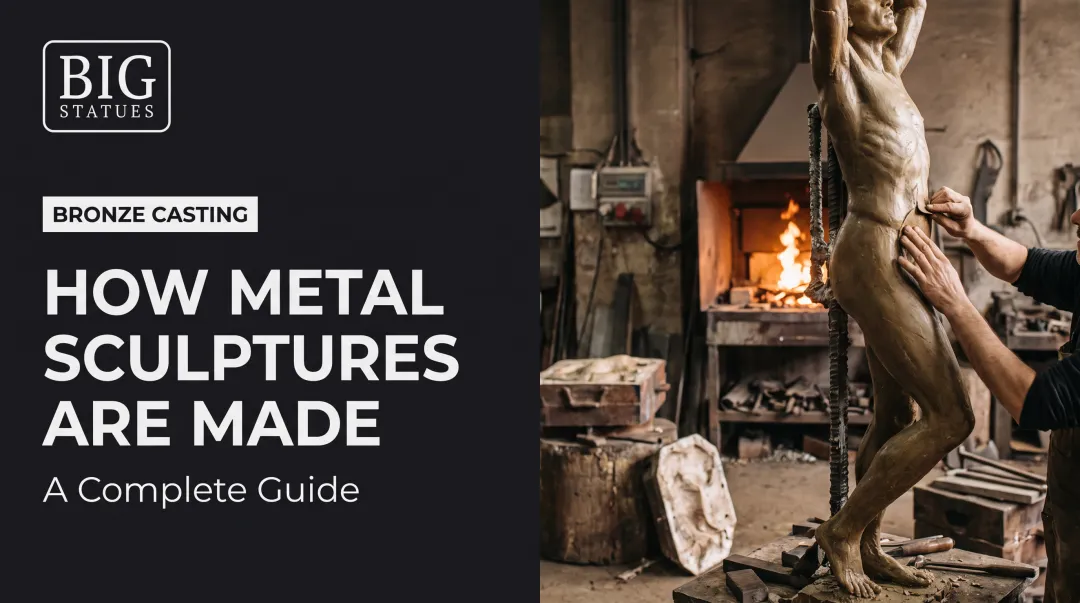
How Bronze Sculptures Are Cast: The Lost-Wax Process
Lost-wax casting hasn't changed much in concept since antiquity, though modern foundries have refined every stage. Here's how it works, from Big Statues' in-house process:
- Sculpting the model. Artists build a steel armature and foam core, then apply hundreds of pounds of clay to sculpt the full-scale design. Clients review and approve renderings before this stage begins.
- Mold-making. The finished clay sculpture is covered in layers of polyurethane or silicone rubber to capture every surface detail, then reinforced with a rigid plaster jacket.
- Wax pattern and chasing. Once the clay is removed, the mold produces a hollow wax replica. Artists inspect every inch, repairing air bubbles and imperfections in a process called wax chasing.
- Ceramic shell and burnout. The wax replica is coated in ceramic slurry, forming a heat-resistant shell. Heat then melts out the wax, leaving a hollow cavity ready for metal.
- The pour, welding, and finishing. Molten bronze, heated to nearly 2,250°F, fills the cavity. Large sculptures are cast in sections, then welded together, sandblasted, and chased to remove seams before a final patina is applied.

Big Statues manages this entire sequence in-house using 100% USA bronze: design, sculpting, molding, casting, and finishing. Every stage stays under one roof, so quality control remains consistent from clay to final patina.
How Much Does It Cost to Cast a Bronze Sculpture
There's no honest per-pound or per-inch price that applies industry-wide. A flat formula can't capture how much labor a custom bronze commission actually takes.
What actually drives cost:
- Size and scale — a life-size figure and a monument-scale installation need very different labor hours
- Detail level — facial likenesses, intricate textures, and fine surface work add sculpting and chasing time
- Project scope — multiple figures, complex bases, or edition runs introduce extra production stages
- Foundry labor — weeks of sculpting, mold-making, casting, and finishing outweigh the cost of the raw bronze

That labor focus shows up in public-art budgeting too. Industry guidance from Americans for the Arts recommends allocating at least 50% of a public art budget to fabrication and 10–20% to the artist fee.
Plan for costs beyond the sculpture itself:
- Pedestals and bases
- Site preparation and foundation work
- Shipping, rigging, and crane fees for installation
- Permits, where applicable
Big Statues' custom commissions start at a $5,000 minimum. Most full projects take four to eight months from signed agreement to delivery.
You get a project-specific quote and an on-time delivery guarantee, with shipping and installation coordinated well before any public unveiling.
Are Bronze Sculptures Worth the Investment?
Bronze's physical durability is well documented. Its financial appreciation is a separate question entirely.
What actually holds value:
- Original, artist-crafted works—not mass-produced replicas
- Documented provenance: signed contracts, foundry marks, edition numbers
- Reputation of the foundry and the artist behind the design
- Condition and quality of the patina over time

Heritage Auctions' research on Remington bronzes makes the gap plain. Authentic, well-documented lifetime casts have sold for well over $100,000, while later reproductions from expired copyrights often bring only a few hundred dollars. The material is identical. The difference is authenticity and documentation.
For most commissioners, though, financial appreciation isn't the point. Consider Big Statues' 2019 commission for Bob Moore, founder of Bob's Red Mill, created to celebrate his 90th birthday at the company's Milwaukie, Oregon headquarters.
That kind of piece isn't intended for resale. Its value is commemorative: a permanent marker of a person, milestone, or legacy that a family or organization wants preserved for the long term.
If value matters to you, protect it by keeping:
- The original contract and artist agreement
- Foundry invoices and alloy specifications
- Photographs documenting the process and installation
- Any maintenance or conservation records
Commissioning a Custom Bronze Sculpture: What to Expect
Bronze commissions come from a wide range of clients, each with different goals:
- Municipalities and government agencies honoring history or civic figures
- Veterans groups and memorial committees
- Universities commissioning mascots or commemorative pieces
- Corporations building brand landmarks
- Private families memorializing loved ones
Whatever the client type, the process runs through the same core stages:
- Free quote and design consultation
- Research and planning
- Clay sculpting
- Mold-making
- Wax and ceramic-shell work
- Bronze casting
- Finishing
- Coordinated shipping and installation

Why foundry selection matters: A studio that handles design, sculpting, and casting entirely in-house avoids the miscommunication and delays that come from juggling multiple vendors. Big Statues brings over 25 years of experience to this process, with a track record that includes public art commissions for the City of West Plains, Missouri. That work used the same eight-stage framework applied to every project, public or private.
Most custom commissions take four to eight months from signed agreement to delivery, though size, complexity, and approval timelines can shift that window.
Frequently Asked Questions
How much does it cost to have a sculpture cast in bronze?
Costs vary widely based on size, detail, and scope. There's no fixed per-inch price. Custom commissions typically start around $5,000, with most projects requiring a project-specific quote for accuracy.
How do you cast a sculpture in bronze?
The lost-wax process starts with a clay or wax model, followed by mold-making, wax pattern creation, ceramic shell investment, and a molten bronze pour. Welding, chasing, and patina application finish the piece.
Are bronze sculptures worth anything?
Genuine, well-documented bronzes from reputable artists and foundries tend to hold value due to durability and craftsmanship. Provenance and authenticity matter more than the metal itself.
What kind of metal is bronze?
Bronze is a copper-based alloy, traditionally copper and tin. Modern sculpture bronze often includes a small percentage of zinc as well—Big Statues uses roughly 97% copper, 2% tin, and 1% zinc.
Is bronze a cheap metal?
Raw bronze is moderately priced, but it's rarely the main cost driver in a sculpture. Labor, sculpting, mold-making, and finishing account for most of the total project cost.