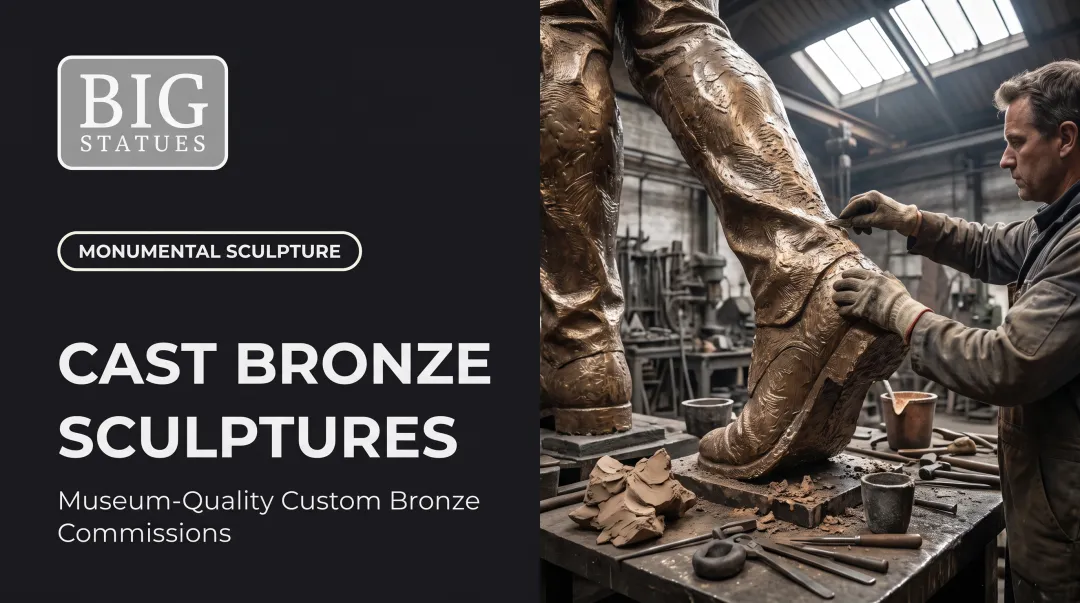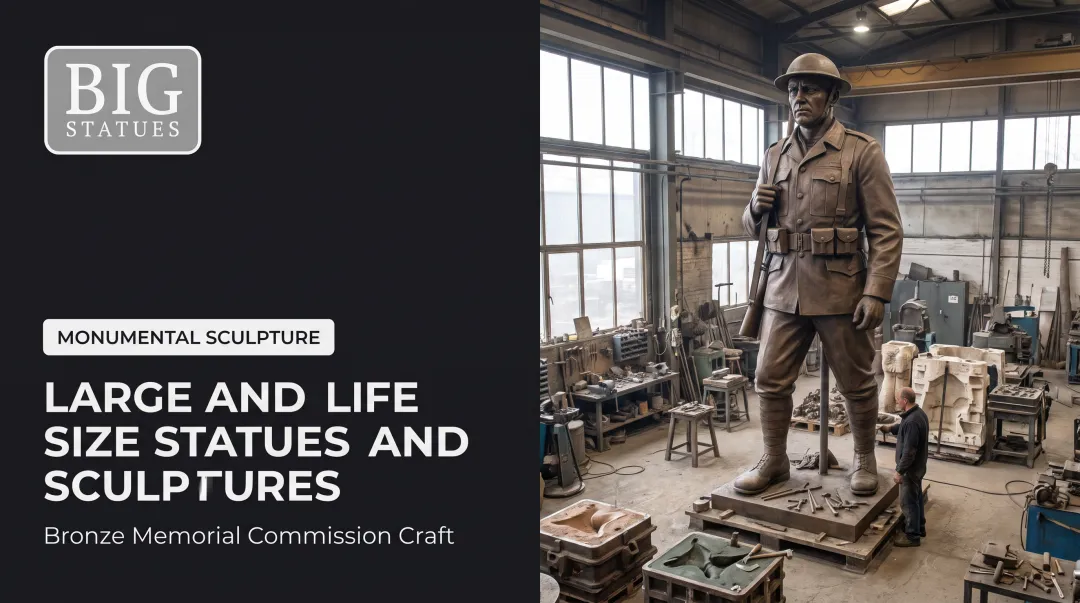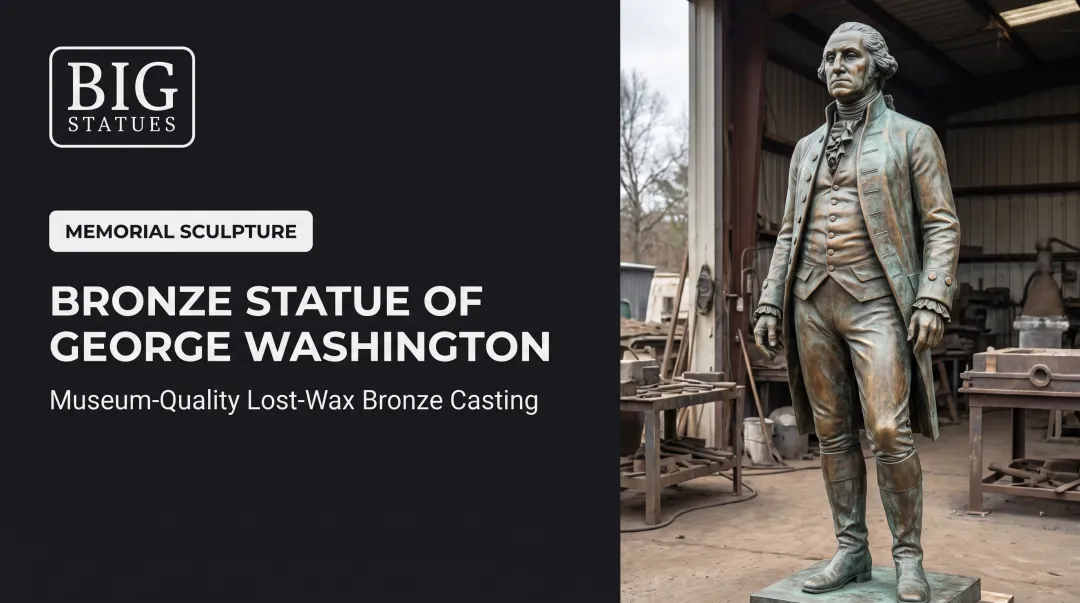

Cost depends on size, design complexity, casting technique, and whether you're commissioning something brand-new or working from an existing design. This guide breaks down the real cost components, using insights from Big Statues' 25+ years running a USA bronze foundry.
Key Takeaways
- No fixed national price for a life-size (5–6.5 ft) custom bronze statue; costs are project-specific
- Custom commissions with Big Statues start at $5,000, scaling with size, detail, and scope
- Main cost drivers: size, detail level, casting method, and whether you need a new clay model
- Adapting an existing design can lower costs, though most foundries still quote each project individually
- A USA foundry means tighter quality control without overseas sourcing guesswork
How Much Does a Life-Size Bronze Statue Cost? (Pricing Overview)
Here's the uncomfortable truth: there's no fixed price for a life-size bronze statue. Costs shift depending on the foundry, the design's complexity, and your exact specifications. Anyone quoting you a flat number without seeing your project details is guessing.
Common budgeting mistakes that trip people up:
- Underestimating shipping and installation (rarely included in the quoted statue price)
- Choosing a foundry based on price alone, without checking craftsmanship or experience
- Overlooking long-term outdoor maintenance, which adds up over decades
Typical Cost Range
Because every commission is project-specific, budget by tier instead of expecting a single sticker price. Big Statues' documented starting point for any custom project is a $5,000 minimum, with final cost driven entirely by your specifications.
Entry-Level Tier
Typically includes: simpler forms, standard finish, and minimal revisions.
Best for: private buyers and smaller memorial pieces when budget is the main constraint.
Mid-Range Tier
What you get: semi-custom detailing, standard bronze thickness, and moderate approval cycles.
Best fit: corporate lobbies, university mascots, and community pieces that need a recognizable likeness without full museum-grade detail.
Premium/Museum-Quality Tier
Typically includes: full custom sculpting, thicker bronze walls, hand-finished patina, and multiple client approval checkpoints.
Big Statues' in-house design-to-mold process sits in this tier. Research, 3D renderings, and hand-sculpting hundreds of pounds of clay onto a steel-and-foam armature all happen under one roof, not split across separate vendors.
Best for: municipal memorials, veterans monuments, and public art installations where precision and permanence matter most.

Key Factors That Affect the Cost of a Life-Size Bronze Statue
Pricing hinges on artistic, technical, and production decisions made long before any bronze gets poured.
Size, Weight, and Scale
Cost doesn't creep up gradually as height increases toward true life-size. It jumps. More height means more bronze volume, larger molds, additional cast sections, more welding, and heavier internal support.
Sculptor Sutton Betti reports that moldmaking alone can take 60-70 hours, with life-size assembly adding another 60-120 hours depending on complexity. Every additional inch of height compounds labor across every stage.
Design Complexity and Level of Detail
An abstract, simplified pose costs far less than a hyper-realistic figure with clothing folds, hair texture, or detailed facial features. Betti's studio notes that moldmaking complexity can cost nearly as much as the bronze casting itself, once you factor in multiple sections and intricate texture work.
Casting Technique and Bronze Quality
Nearly all reputable foundries use lost-wax casting: a clay original becomes a wax replica, which is coated in ceramic shell, fired out, and replaced with molten bronze.
Wall thickness matters more than most buyers realize:
- Thinner walls (~1/8 inch / 2-3mm): Lighter, cheaper, shorter outdoor lifespan
- Thicker walls (~1/4 inch / 5-7mm): More durable, better suited to decades outdoors
Big Statues uses an approximately ¼-inch bronze layer (roughly 6.35mm), which lands solidly in the thicker, more durable range.

Custom Commission vs. Existing Design
Building a brand-new clay model from scratch adds significant cost and time. The Metropolitan Museum of Art explains that indirect lost-wax casting preserves the original mold. That process allows multiple substantially identical bronzes to be cast without recreating the clay work each time.
If a foundry already has a similar mold, you may save on the modeling phase, but casting, finishing, and installation still apply.
Foundry Reputation and Origin
USA-based foundries, overseas factories, and renowned individual artists all price differently, and quality control varies just as much. Working with an experienced US foundry like Big Statues means:
- Design, sculpting, and molding stay under one roof
- Client approval happens at every phase before production advances
- No overseas shipping delays or inconsistent quality control
Cost Breakdown of a Life-Size Bronze Statue Project
Your total investment covers more than just "the statue." Here's what actually goes into the price:
| Cost Component | One-Time or Recurring | What It Covers |
|---|---|---|
| Design & clay modeling | One-time | Sculpting the original figure; higher cost for fully custom subjects |
| Casting & bronze pour | One-time | Lost-wax casting, welding, chasing (surface detailing) |
| Patina & finishing | One-time | Coloring process affecting final appearance and weather resistance |
| Base, shipping & installation | One-time | Concrete base, anchoring, freight — frequently overlooked |
| Long-term maintenance | Recurring | Periodic cleaning and wax coating to preserve patina |
Big Statues runs each commission through eight stages:
- Research and planning
- Clay sculpting
- Mold creation
- Wax refinement
- Ceramic-shell casting
- Bronze pouring at nearly 2,250°F
- Finishing
- Coordinated installation

The full process typically runs four to eight months from signed agreement to delivery.
Don't skip the maintenance line item. The Copper Development Association notes that cast bronze statues can last hundreds of years with proper care — but "proper care" means periodic cleaning and waxing, not a set-it-and-forget-it purchase.
Low-Cost vs. High-Cost Bronze Statues — What's the Difference?
Price gaps usually come down to wall thickness, hand-finishing, and how long the piece is built to last. Here's how budget stock pieces compare with premium custom commissions.
Bronze Thickness & Durability
- Lower-cost: Thinner walls (2-3mm), shorter outdoor lifespan, higher risk of denting or warping
- Higher-cost: Thicker walls (5-7mm), built to withstand decades of outdoor exposure
Detail & Craftsmanship
- Lower-cost: Simpler forms, minimal hand-finishing, fewer approval checkpoints
- Higher-cost: Intricate detailing, museum-quality finish, multiple rounds of client review before casting
Long-Term Value
- Lower-cost: Higher risk of cracking, finish failure, or needing early replacement
- Higher-cost: Retains value over time and becomes a lasting community or family asset

How to Estimate the Right Budget (And Avoid Common Mistakes)
The "right" budget depends on your purpose and long-term goals, not just the upfront number on a quote.
Factors to weigh before requesting a bid:
- Purpose of the statue — Memorial, mascot, corporate lobby, or private commission each carry different scope expectations
- Site conditions — Indoor pieces need less engineering than outdoor installations requiring a foundation and anchoring
- Timeline flexibility — Big Statues' documented custom projects typically run four to eight months from signed agreement through delivery
- Long-term maintenance — Budget for recurring cleaning and waxing, not just the initial purchase
Common mistakes buyers make:
- Fixating on upfront price while ignoring bronze thickness or foundry reputation
- Underestimating installation, shipping, and maintenance costs
- Accepting the cheapest quote without verifying craftsmanship or checking references
Choosing a foundry that owns the full process helps you sidestep several of those mistakes. When design, sculpting, molding, casting, and installation stay under one roof, you cut the coordination gaps that lead to missed deadlines or uneven quality. Big Statues' eight-stage workflow builds in client approval at every phase, so likeness or design issues get caught before they turn into expensive problems.
Frequently Asked Questions
How much is a bronze statue worth?
Value depends on size, detail level, artist reputation, and material quality. Life-size custom pieces generally range from the thousands into the tens of thousands of dollars, with museum-quality commissions at the top end.
How much does it cost to cast a bronze statue?
Casting costs scale with size and complexity through the lost-wax process, which requires a new mold, wax refinement, ceramic shell, and bronze pour for each piece. Larger, more detailed figures require more labor at every stage.
How much does it cost to make a custom bronze statue?
Custom commissions cost more than adapting an existing design because they require an entirely new clay model. Big Statues' custom projects start at a $5,000 minimum, with final pricing based on size, detail, and scope.
Why are bronze statues so expensive?
Bronze itself is a costly copper-based alloy, and lost-wax casting requires skilled labor across many stages: sculpting, mold-making, casting, welding, and finishing. Each stage takes time and can't be rushed without sacrificing quality.
Is a brass or bronze statue more expensive?
Bronze fine-art pieces usually cost more than brass, though exact pricing still depends on the alloy mix and fabrication method. Bronze (copper-tin) is preferred for statues because it casts cleanly and holds up outdoors; brass (copper-zinc) is more common in decorative hardware.
How long does it take to cast a bronze statue?
Casting itself can take weeks, but a full custom commission — from clay model to finished installation — typically runs four to eight months, depending on size, complexity, and approval cycles.