
But if you're on a memorial committee, veterans board, or a family trying to honor someone lost, the process feels overwhelming fast. Where do you even start? What symbols matter? Who do you call?
This guide walks through statue symbolism, common memorial types, the commissioning process from start to finish, and how to choose a foundry you can trust with something this important.
Key Takeaways
- Bronze is the preferred material for military memorials—it withstands decades outdoors with proper care
- Battlefield Cross, folded flag, eagle, and Gold Star are the most recognized fallen-soldier symbols
- Commission in this order: form a committee, approve the design, raise funds, then select a foundry
- Big Statues has cast military memorials such as the Flying Doves Pentagon Marine War Memorial and Lompoc’s Fallen Officer Memorial
Understanding Fallen Soldier and Veterans Memorial Statues
The terms get used interchangeably, but they're not quite the same thing. A fallen soldier memorial honors those who died in service. A veterans memorial honors the broader community of people who served, whether they came home or not. Memorial Day is defined specifically around remembrance of those who died in service to the country, in peace and war alike. The VA defines a veteran as anyone who served on active duty and was discharged under conditions other than dishonorable. Neither term has a formal legal statue classification behind it. What matters most is defining who the memorial honors in your project brief and inscription, not the title you slap on the plaque.
Why Bronze, Specifically
Bronze isn't maintenance-free. Metals corrode, and outdoor humidity takes its toll over time. But conservation research from the Getty Conservation Institute shows that bronze can serve for generations when properly coated and maintained. Periodic cleaning and wax application form a protective barrier against weather and pollutants. That's a far better track record than stone, which cracks, or resin, which fades and degrades in sunlight.
Common Poses and Styles
Most military memorials fall into a handful of recognizable forms:
- Kneeling soldier — often paired with a rifle or helmet, conveying grief and reverence
- Saluting soldier — a gesture of respect, commonly used for standing tributes
- Battlefield Cross tribute — boots, rifle, and helmet arranged as a field marker
- Life-size figurative sculptures — realistic portrayals of an individual or historical figure Big Statues has produced work in several of these forms, including a Henrietta Lacks sculpture in South Boston, Virginia, and military-focused pieces such as the Fallen Officer Memorial in Lompoc, California, a six-foot bronze dedicated in 2007.
Types of Veterans Memorial Statues Communities Commission
Communities commission different memorial formats depending on the story they want to tell. Common options include:
- Individual soldier statues: a single figure representing service or sacrifice
- Group or regiment memorials: multiple figures depicting a unit or historical event
- Bronze relief plaques: flat, engraved panels listing names or depicting scenes
- Abstract commemorative sculptures: symbolic forms rather than literal figures
Branch-specific commissions are common too. Big Statues created the Flying Doves Pentagon Marine War Memorial, an eight-foot sculpture honoring Marine Corps service. Municipalities and veterans groups also request statues tied to a specific branch—Army, Navy, Marines, or Air Force—when the memorial should reflect one service clearly.
Symbols Commonly Used in Fallen Soldier Memorials
Symbolism carries weight in memorial design. Getting it right matters, and getting it wrong can feel disrespectful.
The Battlefield Cross (boots, rifle, helmet) is likely the most recognized fallen-soldier symbol in America. The Smithsonian notes its Civil War origin is conjectural rather than confirmed history, but the modern form became a widely used symbol of loss and closure starting in the Gulf War era.
The folded flag appears often in bronze relief work. The American Legion's traditional 13-fold recitation assigns meaning to each fold, touching on themes of country, faith, and remembrance. It's a script rooted in tradition, not federal statute, but it's widely used at memorial dedications.
Other frequently used symbols:
- Eagle — represents the United States itself
- Laurel wreath — a victory symbol dating to ancient Greece
- Saluting figure — a gesture of respect toward the fallen
- Gold Star — traces back to WWI service flags, where a gold star signified a service member who died while serving
- Red poppy — became the American Legion Family's official memorial flower in 1920, honoring WWI dead

Family-commissioned memorials often lean on the Gold Star symbol specifically, since it carries deep meaning for surviving relatives of fallen service members.
How to Commission a Fallen Soldier or Veterans Memorial Statue
Every completed memorial follows a similar path, whether it's a small-town veterans group or a city government.
Form a committee and secure budget approval. Municipal projects typically need a memorial committee or sponsoring veterans organization before design work begins. Peoria County, Illinois, spent eight years on committee-led fundraising and planning for its "A Final Salute" memorial before fabrication.
Define the design concept. Work with families, veterans, or community stakeholders to settle on size, pose, and symbolic elements before contacting a foundry.
Select an experienced bronze foundry. Look for a studio that handles design, sculpting, and casting in-house. That consistency matters when you're trusting one team with an irreversible commission.
Review a scale model before full production begins. Require sketches, 3D renderings, or a scale miniature for approval, and do not authorize full production until you sign off completely.
Plan installation and the unveiling. Coordinate base or pedestal design, site preparation, and ceremony timing well ahead of your target date.
What the Process Looks Like at Big Statues
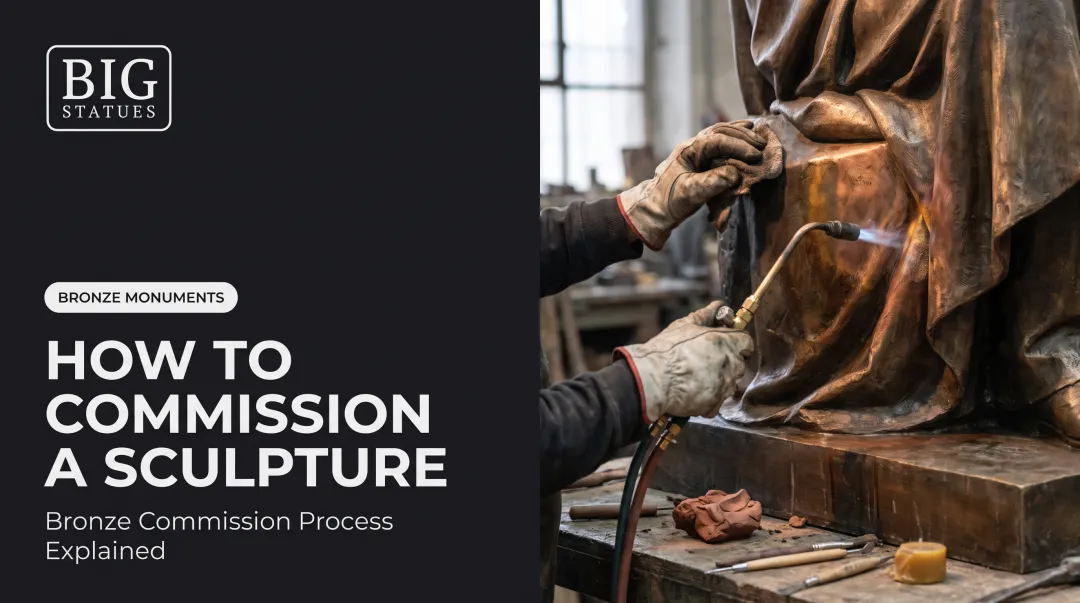
Big Statues runs an eight-stage in-house process:
- Consultation
- Concept approval
- Clay sculpting
- Mold-making
- Wax and ceramic shell casting
- Bronze pouring at nearly 2,250°F
- Assembly and finishing
- Final installation

Most projects take four to eight months from signed agreement to delivery, depending on size and complexity.
Design, sculpting, and casting all happen under one roof with USA bronze, so you are not coordinating multiple vendors when a dedication date is already fixed.
Honoring the Fallen: Etiquette and Best Practices
Getting the tribute right involves more than the statue itself.
Ways to honor a fallen soldier:
- Attend or host a remembrance ceremony
- Observe a moment of silence
- Place a flag, wreath, or poppy at a grave or memorial
- Support a memorial statue fund in your community
**What not to say: Memorial Day honors those who died in service; Veterans Day honors everyone who served. Saying "Happy Memorial Day" misses the point entirely. TAPS (Tragedy Assistance Program for Survivors) suggests alternatives like "Have a meaningful Memorial Day" or simply "Remember and honor those who served."
TAPS also notes that using a fallen service member's name and sharing a memory won't upset a grieving family. They're already living with the loss. Silence around it often feels worse than a genuine mention.
Those same principles of care apply when you commission a memorial.
Personalize the tribute. Adding a dedication plaque with names, dates, and service branch turns a statue into a specific, lasting tribute. Big Statues offers custom bronze plaques as a separate service, developed through preliminary drawings and a 3D approval model before casting.
Planning and Funding Your Memorial Project
Funding rarely comes from one source. Most successful memorial projects combine:
- Municipal budgets — Bastrop, Texas, for instance, allocated up to $500,000 for a full veterans memorial project including artist fees and site work
- Corporate sponsorship — Myrtle Beach's Vietnam Veterans Memorial received a $50,000 donation from a local bank toward its three-statue installation
- Community fundraising campaigns — donor bricks, plaques, and limited-edition bronze miniatures are common recognition tools
- State grants — Oregon's Veterans and War Memorials Grant program covers up to 80% of eligible costs with a 10% match requirement

Before committing to a foundry, get multiple design concepts and transparent pricing. Costs vary enormously by size, detail, and complexity, so avoid anyone quoting a flat "typical" price without seeing your project scope first.
Big Statues quotes projects starting at a minimum of $5,000, with final pricing depending on size, detail level, and scope. With more than 25 years of foundry experience and work featured in national media and galleries, the studio works with municipalities and veterans groups on permanent memorial commissions.
Frequently Asked Questions
How do you honor a fallen soldier?
Attend a remembrance ceremony, observe a moment of silence, or place a flag or poppy at their memorial. Supporting a community memorial statue fund creates a lasting tribute that outlasts any single ceremony.
What to say when a soldier dies?
Use the person's name and share a specific memory if you have one. TAPS (Tragedy Assistance Program for Survivors) notes that grieving families usually welcome this—silence often feels worse than a simple acknowledgment.
What not to say to a veteran on Memorial Day?
Avoid "Happy Memorial Day," since the day honors those who died in service, not a celebration. Save "thank you for your service" for Veterans Day, which honors everyone who served.
What is the symbol for a fallen soldier?
The Battlefield Cross (boots, rifle, and helmet) and the folded American flag are the two most widely recognized symbols. Both appear frequently in bronze memorial statues across the country.
What symbol represents Memorial Day?
The red poppy and the American flag are the most recognized symbols. The poppy became the American Legion Family's official memorial flower in 1920, honoring soldiers who died in World War I.