
New York has always used bronze to tell its stories. But the recent installation of Thomas J Price's "Grounded in the Stars" brought fresh attention to the medium, sparking conversations about who gets memorialized in public space and why.
This guide covers the city's must-see bronze sculptures, the craft behind them, and how custom bronze commissions work outside the museum world.
Key Takeaways
- NYC's public bronze collection spans Times Square, Rockefeller Center, and subway stations citywide
- "Grounded in the Stars" debuted in Times Square in spring 2025 as a temporary 12-foot bronze installation
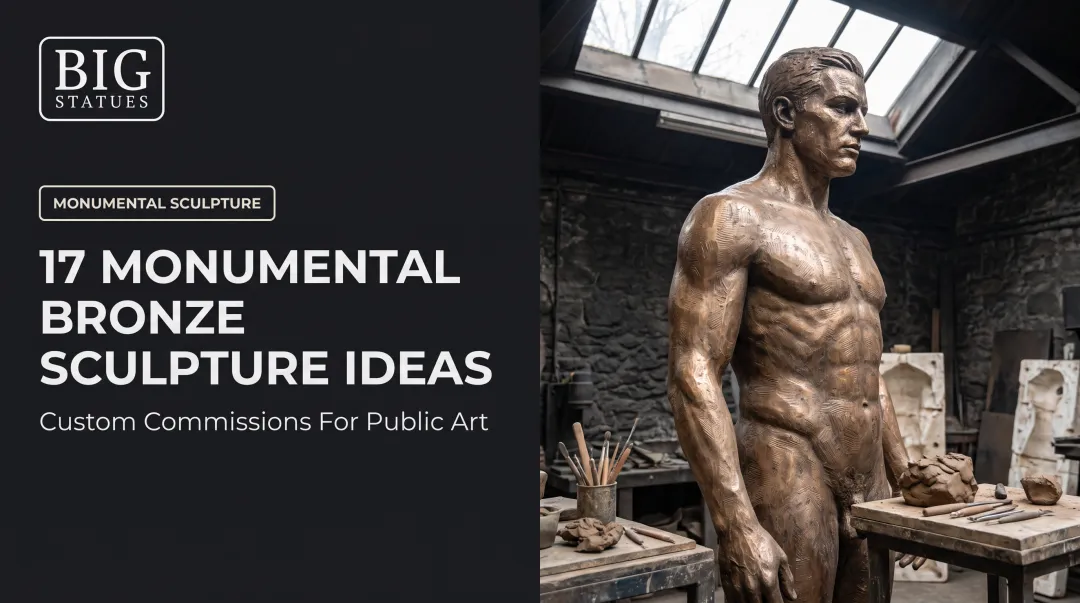
- Bronze stays the top choice for public monuments for durability and fine detail
- Universities, police departments, and private families commission custom bronze, not only cities and museums
Famous Bronze Sculptures You Can See in NYC Today
New York's bronze landmarks range from brand-new installations to century-old monuments. Here's where to find the most significant ones.
Times Square's "Grounded in the Stars"
At Broadway and 46th Street stands a 12-foot bronze sculpture unlike any statue Times Square has hosted. Created by artist Thomas J Price, it depicts a fictional young Black woman in everyday clothing, standing in a relaxed contrapposto pose.
The piece connects to Price's exhibition "Resilience of Scale" at Hauser & Wirth, which ran alongside the public installation. Nearby digital billboards displayed Price's stop-motion "Man Series" animation throughout May 2025, extending the artist's work beyond the sculpture itself.

Rockefeller Center's Iconic Bronze Figure
Rockefeller Center's "Prometheus," created by Paul Manship in 1934, is one of the most photographed sculptures in the city. This 18-foot, eight-ton gilded bronze figure depicts the Greek Titan delivering fire to humanity and sits in the lower Plaza above the skating rink.
Manship designed it as part of Rockefeller Center's broader artistic theme, "New Frontiers and the March of Civilization."
Hidden Bronze Gems in the Subway
Most tourists never see Tom Otterness's "Life Underground" series, and that's part of its charm. Otterness began installing the series in 2001 at the 14th Street/Eighth Avenue station (A/C/E/L lines). Dozens of small bronze figures hide in unexpected places:
- Tucked into stairway railings
- Perched on benches
- Peeking from behind pillars
- Embedded in walls near turnstiles
The figures are whimsical, cartoonish, and easy to miss if you're rushing to catch a train.

Charging Bull and Central Park Monuments
Beyond the subway's hidden figures, a few bronzes define the city's public image. Arturo Di Modica's Charging Bull, installed near the New York Stock Exchange on December 14, 1989, remains one of the most recognizable bronzes in the world. Its current home at Bowling Green draws steady crowds year-round.
Central Park holds more of that monumental tradition:
- General José de San Martín (Louis-Joseph Daumas, 1951) at Central Park South
- William Tecumseh Sherman (Augustus Saint-Gaudens, 1903) at Grand Army Plaza, the general on horseback led by an allegorical figure
Together, these works show how bronze has marked New York's streets, stations, and parks for nearly a century.
The Story Behind NYC's Newest Bronze Landmark
Price's sculpture wasn't randomly placed. Times Square Arts specifically chose the location to contrast with the area's traditional statuary, most of which depicts male historical figures. The woman's stance references Michelangelo's David, borrowing classical sculptural language for a figure who represents no one in particular.
That choice sparked real debate. Coverage split in two directions:
- The New York Times reported backlash that included racist and sexist commentary online
- Hyperallergic's on-the-ground interviews found many visitors praising an ordinary Black woman at monumental scale—something rarely seen in public art
Unlike Manship's Prometheus or Saint-Gaudens's Sherman monument, this piece was always meant to be temporary. Official listings give slightly different closing dates (June 14 versus June 17, 2025), reflecting how quickly rotating public art can move compared to the permanent memorials most cities commission.
Why Bronze Is the Material of Choice for Lasting Public Art
Bronze isn't the only option for outdoor sculpture, but it's the one sculptors keep returning to.
Durability: The Victoria and Albert Museum notes that bronze is strong and durable. That strength is hard to match with stone, which must be carved away rather than cast, or with resin, which weathers differently outdoors.
Detail retention: This is exactly why Price and Otterness chose bronze for their figurative work. Facial expressions, clothing folds, and small gestures survive the casting process with remarkable fidelity.
Longevity: There's no universal lifespan guarantee for outdoor bronze. It has a centuries-long track record as a sculptural material, and a properly maintained patina can slow further corrosion.
New York's own Sherman Monument, standing since 1903, is proof that a well-cared-for bronze piece can outlast generations of viewers.
That said, bronze isn't maintenance-free. Weather, pollutants, and moisture can still cause active corrosion over time, which is why cities schedule regular cleaning and waxing for their outdoor monuments.

How Custom Bronze Sculptures Are Designed and Cast
Bronze casting hasn't changed much in concept since ancient times, even though modern foundries have refined the process. Here's the general sequence:
- Research and planning — Define the concept through sketches, scale miniatures, and reference photos
- Clay modeling — Build a steel armature, add a foam core, and sculpt hundreds of pounds of hot clay over it
- Mold-making — Cover the finished clay model in layers of rubber, reinforced with a plaster jacket
- Wax casting — Create a wax positive from the mold and repair any imperfections ("wax chasing")
- Investment shell — Dip the wax in ceramic slurry, then melt out the wax to leave a cavity
- Bronze pour — Pour molten bronze (heated to nearly 2,250°F) into the shell and let it cool for hours
- Finishing — Break away the ceramic, weld seams, chase details, and apply the final patina

This is exactly the process our team follows at Big Statues. We keep design, sculpting, and molding entirely in-house. When one team controls the concept sketch through the final wax chase, nothing gets lost in translation between subcontractors.
Every casting uses 100% USA bronze, with an alloy composition of roughly 97% copper, 2% tin, and 1% zinc, poured to create a bronze layer about a quarter-inch thick.
You don't need to be a museum or a city to commission this kind of work. Municipalities, universities, police departments, and private families all order custom bronze memorials and statues.
Recent commissions include:
- A tribute statue honoring Bob Moore, founder of Bob's Red Mill, for his 90th birthday at the company's Milwaukie, Oregon headquarters
- Two public sculptures for West Plains, Missouri — "Feel the Love" and "I, Too, Am America" — that now anchor public space in that city
The same craft behind Times Square's newest landmark is available to a veterans group memorializing local heroes or a university honoring its mascot.
Where to View and Experience NYC's Bronze Sculptures
Planning a bronze-focused walk through Manhattan? Here's how to make the most of it:
- Times Square: See "Grounded in the Stars" at Broadway and 46th Street while it's up; confirm closing dates on official listings (sources cite June 14–17)
- 14th Street subway station: Ride the A, C, E, or L and scan benches, railings, and pillars for Otterness's hidden figures
- Rockefeller Center: View Prometheus above the ice rink at the lower Plaza; go early to beat the crowds
- Bowling Green: Catch Charging Bull early, before tourist traffic peaks, for clearer photos
- Central Park entrances: Add the San Martín and Sherman monuments near the park edges to a longer loop
Pair the route with nearby stops like Bryant Park or the Theater District for a fuller day of NYC art and culture.
When you photograph public sculptures, keep a respectful distance from restoration areas and roped-off sections, especially around older monuments in conservation.
Frequently Asked Questions
Is there a bronze statue in Times Square?
Yes. Thomas J Price's "Grounded in the Stars" stands at Broadway and 46th Street. Sources list the installation closing as either June 14 or June 17, 2025.
Who is the new bronze statue in New York?
The new piece is a fictional young woman by Thomas J Price, built from composite references rather than any real person. It stands for everyday identity, not a named historical figure.
What is the bronze statue in Rockefeller Center?
It's "Prometheus" by Paul Manship, an 18-foot gilded bronze installed in 1934. It depicts the Greek Titan bringing fire to humanity and sits in the lower Plaza.
How long do outdoor bronze sculptures typically last?
Bronze has a centuries-long track record outdoors, holding up to weather better than many other materials. Actual longevity depends on alloy, environment, and ongoing maintenance rather than a fixed number of years.
Can anyone commission a custom bronze statue?
Yes. Municipalities, universities, police departments, veterans groups, businesses, and private families all commission custom bronze work. Big Statues has produced pieces for corporate clients, public art programs, and personal memorials alike.
How much does a custom bronze sculpture cost?
Pricing depends on size, detail level, and design complexity, with projects typically starting around $5,000. For an accurate estimate, request a custom quote from an experienced USA-based foundry.